The last couple days I’ve been taking stock of this freelance writing journey. It’s been almost four months since I quit my job at the treatment center, said goodbye to the awful commute from Long Beach to Woodland Hills, and committed myself to writing. And I think I’m coming to peace, to a sense of serenity, at this moment. I’m not making a lot of money. In fact, it’s still a struggle, and I just started picking up tutoring. But so far, it’s been worth it.
When I first started trying to get bylines, I was so pumped to have calendar pitches accepted at the LA and OC Weekly — listings for events in the area. I remember I must have spent five hours on 200 words, thinking that someone might see my work and want me to write more. Well, that was my start, and I’m forever grateful for those pieces (which I still write sometimes), but now I’m publishing more, and as Heron pointed out to me last night, I’ve come a long way. I am happy with the progress of my writing.
But I miss many aspects of the full-time job. I miss being able to go dinner. I miss be able to pay parking tickets without it ruining my week. I miss being able to walk down to E.J. Malloys on Broadway and buy a few beers, a cheeseburger and fries, and talk shit about a sport I didn’t care about with a stranger I would never talk to again. I miss being able to bring home flowers to Heron whenever I felt like it. I miss being able to take flights home to see my friends in Massachusetts. I miss seeing my family and buying a steak every once in a while. Though I have come to terms with all that.
I have a dream. I have a goal. I want to make writing my life. And I’m not entirely sure where that’s going to take me yet. I’m not exactly sure when I’ll go back to working full time, because if there is an opportunity out there that I can’t refuse, I’ll probably take it. But one thing is for sure — I will find a way to write.
So this was all running through my mind tonight. And earlier, I was talking to my Uncle in Pennsylvania. He was always a man I admired. Very successful. A guy who could probably do anything in the world and be successful at it. Then he was asking me how I was doing. I was telling him how I was getting hitched in February and that I was a freelance writer. I was telling him there were ups and downs. I was telling him that I was actually being paid to write. I was telling him about living in Long Beach, California all the way from Clinton, Mass.
He was impressed. Then I said to him, but you know, sometimes I wish I chose another path. Sometimes I wish I chose a job that paid better right away. Sometimes I wish that I picked a career with a more definite career track. Sometimes I wish I didn’t have to pay my dues without knowing what the dues were going to get me. But then I realized, in the middle of talking to him, that I didn’t have a choice. This way of life, well, it had chosen me. There’s nothing I can do about it.
The last week was great, because I was able to take some time away from pitching and writing and step back a bit. I’ve been freelancing, now, for four months, and it’s time to take stock of where I am at. It’s a difficult journey, but I have great support. Over the last two weeks, I have had work appear at the LA Weekly, OC Weekly, and Salon.com, but when I look back on the last four months, my creative work has suffered a bit. I’ve been so focused on trying to write for projects that will help me survive that I’ve forgotten, to some extent, about poetry, about short stories, about my memoir.
Maybe that was a part of the plan. Maybe I needed some distance. And when Thanksgiving “break” came, I found myself writing a new story, and it was my first true science fiction story. It’s set in a Los Angeles in the future, and while I feel somewhat nerdy writing the story, it’s been a pleasure to allow my imagination to wander — to envision a new world. And this has helped rev up the creative process.
This would have never happened four years ago. I would never have even given science fiction a chance.
When I was in graduate school, I started out only interested in literary pieces. I was (and still am) a huge fan of Tobias Wolff, Denis Johnson, Stuart Dybek, Hemingway, Raymond Carver, and Junot Diaz, and I only cared about one story — the lyrical, literary story. I actually had a teacher in undergrad, after much pleading to tell me where I needed to grow as a writer, tell me that I only valued the realistic story.
But when I got to FIU, I met a teacher who started to introduce me to genre — especially Noir and horror. I was resistant at first. I thought genre was for hacks who wanted to make money. Then I started to read Raymond Chandler, H.G. Wells, Robert Louis Stevenson, Nathaniel Hawthorne, and Herman Melville. One of the best anthologies this teacher suggested was the American Fantastic Tales: Terror and the Uncanny From Poe to the Pulps. I suddenly became aware of the tremendous possibilities of genre and the infinite combinations — even surrealism, abstraction, the philosophically stirring existed within the forms. Yes, I was ignorant and stubborn, but I was learning. So I read everything from Dr. Jekyll and Mr. Hyde and The Island of Dr. Moreau to Borges, and I saw similarities and possibilities.
Now, this isn’t any new revelation. Just look at Michael Chabon and many other writers experimenting with genre. But I was suddenly freed from the reality that all writing had to be real and true. Truth is a word, anyway, that has nothing to do with facts or even reality.
So I wrote my first horror story at FIU, and at first, it was torn apart, somewhat, in the workshops. I had a tendency, then, and a tendency, now, to go over the top. So I revised and worked on it. And about two weeks ago, it was accepted into a future anthology by Sirens Call Publications. The story is called: “The Castle on the Hill.” The anthology is a haunted mental-ward theme.
My point is this: sometimes in order to feel free again, to be reminded of the infinite possibilities of this world, of art, of writing, it’s important to live within a form, a genre, a guiding principle. Sometimes it’s not. Sometimes it’s better to be free and without direction. Right now, I feel somewhat stuck in between both ideas.
I’ll wake up tomorrow, and I won’t truly know what the day will bring. I’ll sit down to write a pitch, and I might find a better idea. I’ll sit down to finish a story, and I might end up writing a poem. And maybe it’s only in this searching, in this lost wandering do we come to direction, to guidance, to form. Well, the most important commodity, when it comes to writing, has to be hope. Hope that you will find a thread. Hope that your character will come alive. Hope that you will finish. Hope that you will be appreciated. Hope that you will find the words to say what is pulling at your heart-strings. Hope is what gets us through the feeling of being lost.
And so now, I must come to a stopping point. I didn’t really know where this blog was going to take me. I didn’t know really what was even on my mind.
One of my favorite movies is The Bronx Tales. I don’t know why, because sometimes I think the main actor’s (the guy who played C) performance was a bit stale, even though I can’t imagine anyone else in that role. I swear I can almost retell you that whole movie. One of my favorite parts in the movie is the clip above, when Sonny tells C about the door test. Basically, it’s a test to find out if your date is one of the three true loves. According to Sonny, you only get three.
As for the door test, Sonny says that you take a girl out, and when you pick her up, you make sure the doors are locked — the windows up tight. So you take the girl to the car, you put the key in the door, and you open the door for her. You let her in the car, shut the door, and walk around the back. While you’re walking around the back of the car, you look inside, and your date doesn’t reach over and unlock your door, then you dump her. You dump her right there and move on.
Of course, this test requires that you have manual locks in your car, and how many people still have automatic locks? Well, when I was younger and I had a car with manual locks — a beautiful Subaru Legacy wagon — I used to test every woman who came into my car — even if I wasn’t romantically into them. If they passed the test, then I did sort of think about it.
But I guess this reveals something about how corny I am. So what? I am a guy who believes in true love. I believe that there are certain people out there in the world who are meant to find each other. I know that sounds lame, especially since the woman I’m about to marry, ah hum, failed the door test, but she has spent the last several years making up for it.
And I think these types of test are somewhat important — while more fun than accurate — and it’s a shame that everyone has automatic locks so they can’t perform the love assessment. So I’ve come up with a new test.
Say it’s you and your significant other, and you’re watching a television show together. Make it the brand new episode of Breaking Bad. Well, at this point, you should have a buddy call you — or fake an excuse to go outside. Walk around outside, and wherever you are, make sure you can see your date, and if she doesn’t hit pause on that DVR so you don’t miss a part of the show — dump her. Dump her good. And never look back.
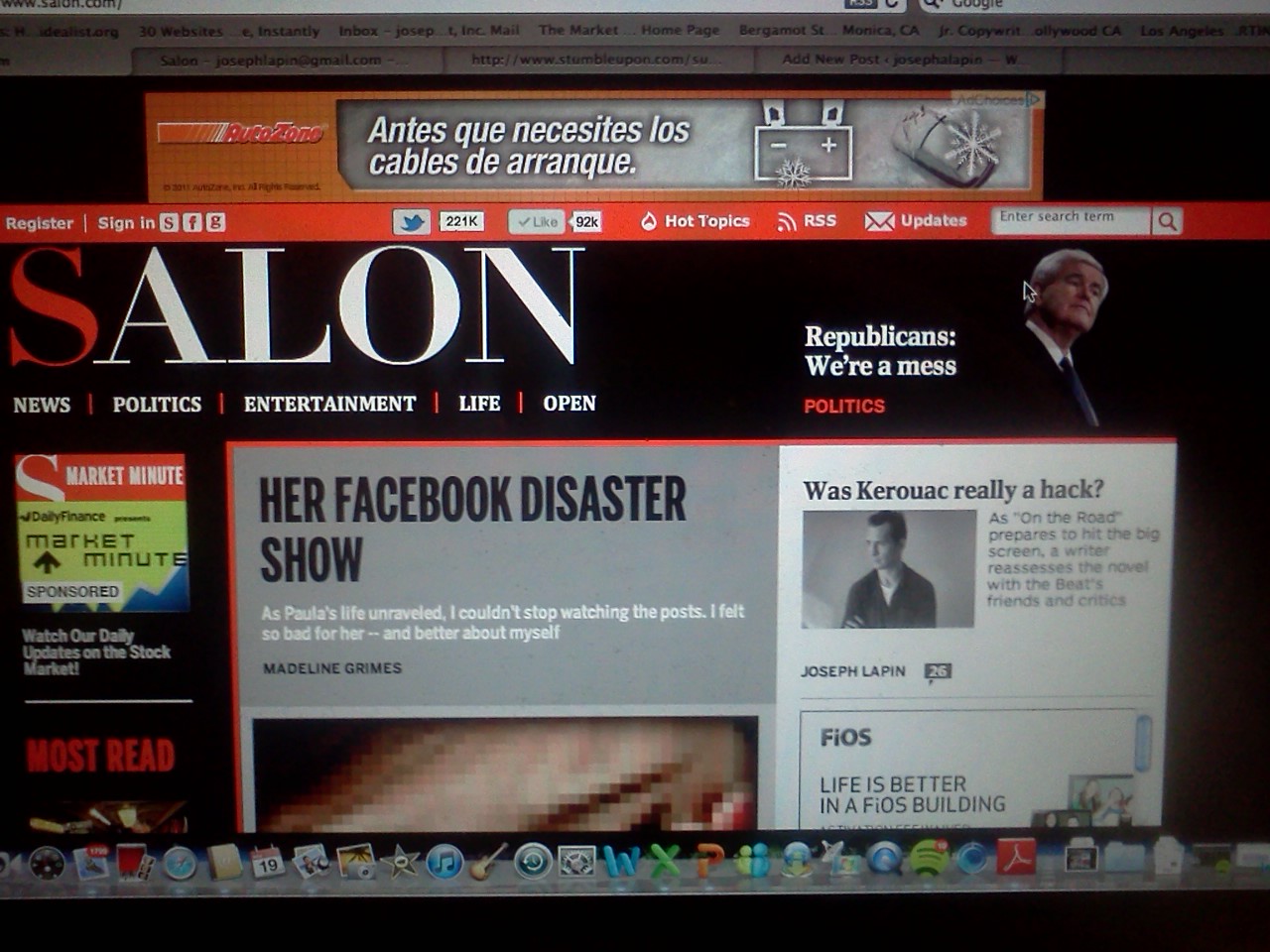
So earlier tonight, I had a piece appear at Salon.com, and it was on Jack Kerouac. If you’ve been reading my blog or you know me, then you probably understand my relation to Kerouac’s work. And the ideas in the piece have been rumbling around in my head since I took Dan Wakefield’s class, New York in the Fifties, while I was at the MFA program at Florida International University. Here’s the piece: Was Jack Kerouac Really a Hack? Give it a read if you have time.
Also, I had a review of Dennis Miller and Adam Carolla’s comedy show at the Grove in Anaheim come out at the OC Weekly earlier this morning.
Today was truly a wild day. With freelancing, there are ups and downs. I wish it could be more even, but right now, I’m going to just enjoy this. Thanks for checking out my blog.
So I wrote the piece targeted at the OC Weekly audience — a readership who is young and with a jazz scene that isn’t traditionally something to write home about, though it’s there. My intention was to write a post introducing people to jazz albums that would be a good entry point. I imagined a young audience searching the web, looking for ways to learn more about jazz, and I wanted to give them a place to go, a place to start. I rigged up a post, thinking about the intended audience — not the grumpy old guard that I knew had a strangle hold over the conversation — and found the full albums on YouTube.
And it was successful. Honestly, it was startling successful — 15,000 likes on Facebook in 24 hours. That’s incredible. People are still coming to the blog to check out the piece. Of course, it was met with criticism, too. You can’t please everybody with these lists. And as I wrote in the first post, “The debate is so polemic that I might as well write about the top ten abortion clinics.” However, there were many people on the site who were listening to the albums and enjoying. I welcomed the comments disagreeing with my choices. That’s part of the game. It starts up conversations about music and jazz and a genre other than pop. And that’s cool.
To my surprise, this wasn’t the end of the piece. I was surfing Twitter and noticed that West Coast Sound (LA Weekly) had picked up the piece. I write for the LA Weekly, too, so I was pleased to see the piece gaining some legs. After that, I received an email from the Dallas Observer, and they told me they were going to use my piece in print and online. I thought, great, a new audience. An opportunity to reach more people. And again, it picked up some criticism and some appreciation. I knew that I was going to take some heat for not having Bird or Dizzy on the list (though I felt their influence was obvious), but the albums were just my opinion. I went with what my gut told me would be a great introduction.
So a week or two later, I’m on my blog, and I see a spike in my stats. I really hadn’t posted anything, and I saw that the hits were being referred from a site. So I clicked on the link, and it was a thread on music writing. Man, the people in that blog were just tearing the list to shreds. Calling me every word in the book to describe a naive and young writer who shouldn’t be engaging in a historic conversation. I imagine these “hip cats” laughing at their wit and swirling around a brandy from their apartments in Brooklyn. Obvious stereotype. They kept talking about some piece I just wrote on jazz. All I kept thinking about was that the jazz piece was published a week or two ago. Why all of sudden?
Honestly, I was a bit surprised it was posted there, since it was written for an audience not familiar with the locales in New York. In the part about Sonny Rollins’ The Bridge, I’m actually describing the Williamsburg Bridge to the reader. You think an audience in New York might know about the Williamsburg Bridge, right? Then I noticed on twitter people calling me a 19-year old, etc. The Village Voice took some heat for it, too. Well, The Village Voice is a storied weekly — the mother of them all — and I was excited to have my piece published there, but it was obviously not the audience I had in mind.
But what I found interesting was that the Editor of Spin Magazine said this on twitter: “Any smart 19 year old with access to a public library has heard enough jazz and can die now.” Then Anthony Dean-Harris posted a beautifully written piece called On Wheat and Chaff. While he’s criticizing me pretty handedly, he’s doing it with style. Seriously though. I can admire good writing when I see it. He’s basically saying that in the age of blog writing, good writing will eventually separate itself from the bad — the wheat from the chaff. Great metaphor. Though it’s an extended metaphor as old as the bible.
You know, I don’t pretend to be an expert on jazz. I haven’t been writing about jazz for 40 years. No shit, I don’t belong in the same sentence with Gary Giddins. But I have a voice and an opinion, and I stand by my piece and the original purpose and audience. Even at The Village Voice, it received 1,000 likes on Facebook. Of course, I’m not trying to defend the piece as a great example of music criticism, but the popularity and negative criticism mean people are at least listening. Most importantly, I’m probably still getting to the young audience I intended the piece for. I guess in the end, the chaff is separated from the wheat — the piece is still finding the audience it was meant to reach.
But what I have a problem with is the idea of a blog aggregator talked about in the wheat and the chaff piece — an expert editorial board surveying blogs and making sure they meet expert standards. Well, Anthony Dean-Harris objects to this idea in his piece, because he says bad writing will eventually expose itself for being bad writing. His example, my piece. He also talks about the freedom of the internet. However, for those realistically thinking about this plan, the idea of blog aggregator is one of the most fascist ideas I have ever heard in terms of writing since I was actually in high school. Okay, so I’ve got a great idea. We could call this new aggregator the Ministry of Intelligence and have it installed in every computer in the world. Before any blog gets posted, it will have to go through a series of editorial boards. Let’s bring bureaucracy to the internet. No, I have a better idea, let’s call them the Vogons.
In a way, while this is hyperbolic, the conversation around jazz is kind of like this already. All I’m trying to do is share my opinion, and the criticism is expected. I welcome it, but when talking about limiting what someone says, keeping the conversation to the experts, well, I disagree. I will keep writing about jazz. And maybe if the dialogue surrounding jazz was more welcoming, then people wouldn’t be talking about the death of jazz. A younger generation wants to be a part of the conversation; they want to express their opinions and say what they don’t understand. They want to learn and speak. And if anything, the response my piece received proves that.
Thanks to everyone who read the piece. But I want to say thanks, specifically, to those who criticized Ten Jazz Albums Before You Die, because without them, who knows how many people would have actually read the piece. In the end, this was my first trashing by a New York elite. It’s kind of like popping a cherry for a writer. And I hope it’s not the last. Because like one of my friends said, the criticism means that my voice has relevance. And I’ll take that any day while a few jabber away.