Category: News

As a creative professional, I’m fascinated by how the news and culture can serve as a way to inspire creativity and examine new trends. Here I share some of my thoughts on the news and the zeitgeist.

Thoughts on the Zeigeist: Deflategate and Balls, Balls, Balls

Deflategate

It’s been a week since the news that 11 out of the 12 footballs the Patriots used in their game against the Indianapolis Colts were reported to be under inflated. The New England Patriots’ footballs were allegedly filled to 10.5 PSI — two pounds below the league minimum. An uproar ensued and America demanded football justice. Bill Belichik and Tom Brady were seen awkwardly answering questions in front of a media that were firing off probing questions as if they were interviewing Obama after he announced that America was planning to invade Canada for their maple syrup. Now the Patriots legacy is under question, and the evidence seems to suggest the Patriots are a bunch of freaking cheaters.

So, yeah, I’m a Patriots fan. I’m almost an obsessed Patriots fan. I read more articles on the Patriots in a given day than any man should, and I study formations, bench players, and strategy as if I thought any day the hoodie would call me up on the phone after a key injury and ask me if I wanted to suit up. “I’m ready coach.” As my brother-in-law says, I’m almost as much of a homer as the guy in the Saturday Night Live skit below, Dougie Spoons. “You think you can do what Brady does?”

Here is why I’m a Patriots fan. I’m from Massachusetts, and while I can’t stand the winters or the short days and the cold, I love my home. I love where I’m from, but I haven’t lived there in almost ten years. I have friends there, and I am aware that I am who I am today because of Clinton, Massachusetts. It built me. So I root for the Patriots, because I’m cheering for my roots. The Patriots represent something about my hometown that sports teams like the Packers and Steelers accomplish for their respected cities. We’re a bunch of wicked hard-working people who battle awful weather. People in Massachusetts are rugged, strong, grumpy; we work jobs that put callouses on our hands; we drink Dunkin Donuts coffee instead of that Seattle crap; and we never quit. We never quit believing that life is about hard work, family, and showing up every day as if it’s our last. We are underdogs. (Of course, this isn’t all Massholes, but these are the ones I love.)

Enter Tom Brady. He’s a quarterback that was benched at Michigan. He was a player who showed up at the NFL combine who looked like he was actually about to be examined for scoliosis.  He is an athlete who no one ever thought would be successful. He was a sixth round draft pick. Now, he is on his way to be the greatest quarterback of all time. He renegotiated his contract to give his team a discount in an era where free agents try to acquire the most money. He never quits. Every year, he leads a team with people like Julian Edelman, Alan Branch, Jermaine Wiggins, Shane Vereen, James Develin — football players who played different positions in college or couldn’t find a spot on any other team. He leads a team of people who were unwanted, undesired…cast off. And they play like a team. They preach team first. They are Massachusetts.

I consider myself an underdog. In high school, I couldn’t even spell, and I had no idea what a comma splice was. I received a D minus my freshmen year in English; I was told that being a writer is like trying to find a way to travel to the moon with a go-kart; and I’m trying to prove everyone wrong. I have a chip on my shoulder. I’m hungry, angry. So how do you think I took the news of deflategate?

It hurt. To think that the team I believe in is using a competitive advantage, one as bush league as deflating footballs, it was like someone just told me my best friend was spitting in my beer every time I went to the bathroom for four years. I wanted to believe that it wasn’t true. It had to be the weather. There had to be an explanation. I’m still a bit torn about this; Bill Nye the Science guy even came out and said Belichik was full of shit:

<iframe width=”853″ height=”480″ src=”//www.youtube.com/embed/dZFiYxI3DFM” frameborder=”0″ allowfullscreen>

It’s a bit suspicious though that Bill Nye is a Seahawks fan. There are so many questions surrounding deflategate (Did the hoodie give the order? Did Brady instruct one of his ball boys to deflate the balls? Didn’t Brady look like he was hiding something in his press conference?) that led anyone with common sense to think that the Patriots are, in fact, a bunch of cheaters. The way that the evidence stands, right now, seems to me that someone in my beloved organization is cheating.

The worst statistic that I have found was a graph on fumbles. People are talking about how Brady was the one deflating the balls to ensure a better grip and a better quality ball, but if the Patriots are deflating balls, then it’s not for the aerial attack; it’s more for the running game and yards after the catch. Look at this graph on fumbles from Slate:

150123_SNUT_Fumble-01.png.CROP.original-original

As you can see in the graph, the Patriots had far more offensive plays per fumble than the second best team in the NFL. It’s almost not even comparable. How could they be that much better at ball security. Granted, the hoodie does preach and practice ball security in innovated ways, and he even had a runner, BenJarvus Green-Ellis, who went an entire year without a fumble. While this seems like a great stat, someone actually looked at his fumbles with the Patriots compared to his fumbles with his next team, the Bengals. From 2008 to 2011, Green-Ellis didn’t have a fumble once with the Patriots. In two seasons with the Bengals, he fumbled a total of five times.

When I look at whether or not the Patriots are guilty, I see a lot of data that suggests that they are, but it’s still not proven.

On the way home today, I heard Boomer Esiason on the radio talking about the Patriots and whether or not they were cheaters. He made an excellent point. In the game against the Colts, Tom Brady under threw Shan Vereen by about five yards. He threw an under thrown interception, where he had Gronk open over the middle. He wasn’t performing well, so if he did deflate the ball the technique wasn’t working. Also, why would Belichik call a second press conference and emphatically state that there was no wrong doing from the Patriots after his first press conference. He knows his legacy is on the line, and he knows that people are suspicious: would he really double down on his teams’ innocence, publicly and emphatically, if we was still cheating? Think about Barry Bonds: he ducked the media on the steroid question.

The answer could be yes, but we don’t really know.

I read another theory from the Boston Globe that was intriguing. Chuck Pagano was the defensive coordinator of the Baltimore Ravens with John Harbaugh, who was pissed that the Patriots used “trick” plays with ineligible receivers  in the divisional championship round. People are starting to get suspicious of a revenge plot from Harbaugh. What I’m reading is that perhaps Pagano and Harbaugh were scheming together to make it look like the Patriots were deflating their balls.

Yes I know that I’m making some paranoid, Homeland type conspiracy theories here, but Harbaugh is pissed. Could it be possible that the Colts inflated their balls outside in the cold temperature, knowing that the balls would lose air if the balls were inflated inside, in order to make it seem like the Patriots were cheating? Could the Patriots actually be innocent? Well, in the words of the great Boston Celtic Kevin Garnett, anything is possible…Let’s go Patriots! Your comments are always appreciated. Hopefully we can start talking about the game this week.


Thoughts on the Zeitgeist: Patriots Ravens, Obama in Paris & the Pope in Diapers

Design by Joseph Lapin

Today I’m beginning a new series called “My Thoughts on the Zeitgeist.” Let me explain. In my role as creative director at Circa Interactive, I have to stay on top of the media to create content that taps into larger trends. I have to remain cognizant of the broader narratives for journalism. I have to understand what’s ahead and building to a boiling point in order to create timely blog content. And I have to continue to find ways to keep my creative pieces relevant by following the world as closely as possible. At work, when we’re in that moment, in the spirit of the times, we call this tapping into the zeitgeist. So I’m always reading the news, and I figured I could use this strategy a bit more for my blog posts. I decided to start a series on my blog that examines a few stories in the media (sports, culture, law, finance, marketing, SEO, literature, etc) and comment on them. Simple as that. This will be the first week.

1. “Bipolar Wackos” in the NFL Playoffs

As you may know, I’m a huge Patriots fan. Tom Brady is a superstar that was once an underdog. I find the team inspiring, and in terms of digital media, the Patriots website is one of the leaders in advancing content marketing and sports business. Like most people, I was absorbed in the playoff game between the Ravens and the Patriots, and I must have read every single article on Twitter about the game and the strange formations.

While I was going trough my twitter feed this morning, a story on 98.5 the Sports Hub’s coverage that caught my attention. It was about a fight between Steve Smith, current Ravens wide receiver, and Jermaine Wiggins, former New England Patriot tight end who became a legend in the tuck-rule game. The big story was that Steve Smith approached Wiggins after the game to let him know that he was upset over being called a bully. Sure, this sounds like two middle schoolers fighting in the parking lot after a baseball game, but it’s sports. So I’m not expecting a conversation analyzing the plot of “American Beauty.”

Scott Zolak, a former Patriot who interviews Belichick on the Bellestrator (the hoodie breaks down film of previous games, and it’s incredible), starts to give a play-by-play of the incident. I’m listening and intrigued, but then he says this: “Steve Smith is a diminutive guy. He’s about as big as Bob Socci. Everything we talked about last week with Suggs being the nut job, the bipolar wacko…”

That’s when I stopped. Did he just say bipolar wacko? A journalist, a commentator, a respected professional in the media really just used bipolar wacko, the nut job, on the radio? Honestly, this comment shows ignorance on the part of Scott Zolak, and it’s a nuisance for anyone who has ever lived with someone with bipolar disorder. If you have needed to help someone who has bipolar, you know how difficult it can be show them that they have an illness, because it’s such a stigma, especially in their own mind. The illness is still viewed as a failure, and people with mental illness have enough problems in the world than to have ridiculous stereotypes and ignorance being shared on the radio.

Okay, I know what you’re saying. I’m being the PC police. Learn to chill out. Take a joke. Well, Scott Zolak is not a comedian. This is a normal conversation on sports radio, and a journalist is using such an ignorant and lazy description to describe one of the most unique characters in the NFL. Don’t get me wrong here, I still have a lot of respect for Scott Zolak and think he’s a great commentator, but I just wish people took more care for how they used the word bipolar and developed a better understanding of the nuances and complications of mental illness. Perhaps Zolak actually does. If so, I wish he would have shown it.

2. Obama Didn’t Show Up in Paris. So? 

Credit: Joseph Lapin

The terrorist attacks in Paris were atrocious. Je Suis Charlie. C’est vrai. The protection of freedom of speech is essential. I believe America clearly stands with Paris in terms of finances, policy, and security issues.

But Obama is taking a lot of heat for not being in Paris to join 1.5 million people, including many important global leaders, who marched down the Boulevard Voltaire on Sunday in a show of unity against extremism. We sent Eric Holder instead, and the world is insulted that Obama or Biden didn’t show up in person.

The White House has since acknowledged that they should have sent a higher ranking official. I just think this criticism is really unfair. Think about it: For one moment German Chancellor Angela Merkel, Israeli Prime Minister Benjamin Netanyahu, Palestinian Authority President Mahmoud Abbas, French President François Hollande and other European and African leaders were in one spot. They were standing together. Yes, it was a great message sent to the terrorists that we were not scared, that we were not bothered by their terror tactics, that we would stand up to extremism everywhere we find it, but it was also like putting a target on the back of every one of those leaders and inviting an opportunity for disaster. In one awful moment, the world could have lost some of its best leaders.

Yes, I get it. That’s the point. Show them we’re not scared. I love the idea. It was a momentous occasion that will definitely go down in the history books, but should Obama ignore his intel? Should Obama ignore the threat? Should he wave the middle finger in front of killers and dare them to kiss his ass?

We were there. Obama was there. I am there. Anyone who believes in human rights was there. I don’t doubt that about Obama. I just believe his staff made a decision they thought was right based on the information they had.

I mean, look what Ted Cruz wrote: “The absence is symbolic of the lack of American leadership on the world stage, and it is dangerous. The attack on Paris, just like previous assaults on Israel and other allies, is an attack on our shared values.”

Bullshit.

3. Now Time for Something Funny 

Credit Derek Peto
Credit Derek Peto

Pope Francis is kind of rock star. He’s seen as a man of the people, and he rides buses and drives old cars instead of going for a spin in a fancy pope mobile. ABC News even reported that he sneaks out of the vatican in tattered clothes as a disguise to treat the homeless and sick. He sounds like a hell of a guy, honestly, and I’m not religious at all.

What’s fascinating about Pope Francis this week is that he’s due to visit the Philippines. When the Pope shows up in Manila, he’s expected to draw an enormous crowd that will put security and facilities at capacity. This is forcing many people in Manila to, well, flip a shit.

“About 2,000 traffic enforcers who will be on duty during the Jan. 15-19 papal visit will be required to wear adult diapers, said Metropolitan Manila Development Authority chairman Francis Tolentino,” reports the AP.

That’s 2,000 government officials in diapers. When I see images of that crowd all I’ll be able to think about is 2,000 people potentially pooping in their pants. It’s not just traffic enforcers either. The people attending the event are also encouraged to wear diapers.

Well, that’s it for my thoughts on the media this week. I’ll probably try this again. Finally, I wanted to leave you with something Aziz Ansari recently tweeted at Ruport Murdoch.

Netflix Drops House of Cards Trailer

Netflix finally release the House of Cards trailer, and they set a release date for season three on Feb. 27. If you’ve lived on planet Earth over the last couple years, then you’ve probably seen “House of Cards.” I’m pumped about this next season. Kevin Spacey plays the most ruthless son of bitch this side of Clint Eastwood. Leave a comment and let me know if you’re excited about the trailer.

I am my Data: WSJ Reports Planes Used in Spying Program

Design By Joseph Lapin

Right now, I’m sitting at the bar in Thorn Street Brewery in North Park, San Diego, drinking an American Strong Ale. B.B. King is on the radio, and a bartender is pouring pints, and she looks like one of the characters out of a Denis Johnson short story. This place feels like it’s about to turn into a juke joint, as they’re now blaring the “Mess Around,” glasses are clinking, and people are talking loudly over the music. The bartender is now shaking her hips, trying to tease the tips out of the wallets. What I’m thinking about is turning to the bald guy in the teal polo sitting on the stool next to me and telling him about a story I read recently in the Wall Street Journal, but I think he would end up thinking I was the neighborhood mad man.

Basically, I want to tell this guy next to me and the old woman drinking a beer in front of me like it’s a hot tea about the brand new American spy program. I want to tell them all about how “the Justice Department is scooping up data from thousands of mobile phones through devices deployed on airplanes that mimic cellphone towers,” as reported by the WSJ. I want to tell them that this program has been instituted secretly since 2007, and it’s really freaking brilliant and scary and wrong and right all at the same time. I want to say this as I hear stiletto heels clomping along the hardwood floors and the bartender now complains how she is so hungover from her birthday last night.

Here’s what happens: the Cessna aircraft “mimic cell towers … and trick cellphones into reporting” their data in hopes of tracking down terrorists or drug dealers. The technology is so impressive that it’s reported to be able to pinpoint targets “under investigation by the government,” and it sweeps thousands of phones at the same time in order to nail down the targets exact location, even within a massive skyscraper, while pushing aside ‘innocent bystanders and “letting go” of their data.

Of course, the Justice Department is neither confirming or denying the report, but they are defending the action by the U.S. Marshals Service, as reported by several sources, and it’s in line with a much larger stance that our government has taken on data: Whatever works for the greater good and security of our country is within the Constitution and, yes, The Dark Knight.

But how many people were shocked by this news? I mean, Kim Kardashian broke the Internet, and it wasn’t the news of another American spy program. Now, relax, I’m not trying to get on a high horse here and discuss why it’s important that we pay attention to the news over celebrities showing their gorgeous and stunning booties (We only have one life [unless you’re a buddhist], and if you want to spend it cramming your brain with celebrities asses and their petty relationships, then I support you; I watch plenty of ESPN), but what really just shocks me is that we still don’t care that our data is being harvested like Monsanto corn and that we still don’t see this massive data collection as an invasion of privacy.

I actually argued this in a Salon article I wrote after I heard that our government admitted to the existence of Area 51, and I’m still trying to make this point today. (People shredded my article on the comment boards.) As a country, we’re so used to our authorities lying to us, spying on us, fucking with us, playing with us, tricking us, mind-fucking us, that we eventually stopped being shocked, we stopped being scared, we stopped caring.

The truth is planes collecting our data on a massive scale with approval from an actual court system that is relatively secret isn’t thought of as shocking anymore. Think about it: we’ve since this well before Will Smith starred in I, Robot. Remember Enemy of the State? This isn’t even the only movie that shows how invaded our civil liberties are in terms of data collection. There are countless.

Our pop culture and news have reported on data invasion more times than Kevin Bacon has appeared in films. I feel somewhat bad for the WSJ. They broke a gigantic story, but it’s already old. It’s almost a footnote in the battle for civil liberties in the digital age. I mean, this is what the ACLU said in the WSJ article:

Maybe it’s worth violating privacy of hundreds of people to catch a suspect, but is it worth thousands or tens of thousands or hundreds of thousands of peoples’ privacy?

So yes, I get it. I’m not an idiot. Advancing technology can have a gigantic impact on the protection of our country. Yes, it’s important to use these new techniques to capture dangerous criminals in order to safeguard our communities, our people, our children, our infrastructure, the very bedrock of the American people. It’s important that I can have the freedom and the safety to sit in this bar and criticize my government while B.B. King just seduces Lucille with so much charm and sex that it feels the sound is about to melt the walls. (Yeah, I’m going overboard with my metaphors, but that’s my right as an American [lol!].) I’m not trying to take the stance that data can’t be used to help fight crime, but I am against the idea that collecting my data isn’t an invasion of privacy.

When the U.S. Marshals fly over “most of the U.S. population” collecting the remnants of my cellphone, I take that personally. I read that as they’re literally snatching pieces of my unconscious and conscious thoughts. What I surf on my phone, my location, my texts, my browsing history are really intensely personal parts of my existence. It’s like when someone drives your car and rifles through your music collection or the police walk into your home and check your browsing history or that Spotify is sharing with the world what you’re currently listening to without fully being cognizant of this information.

I am my data, and when I was born as an American, I didn’t sign a freaking terms of service that allowed the government to invade my privacy. I take offense to my government collecting my data with planes and fake cell phone towers without my permission, without my knowledge. Perhaps I would be all right with this type of security if I was given the options and the collection of my data was guaranteed to be private, but I don’t trust my government yet. I believe that whatever technology the media reports on the Justice Department will already be 1,ooo steps behind what  technology their currently using to “protect” our lives and invade them at the same time.

Wow, someone in the bar behind me just yelled, “you’re a fucking sniper.” Well, that’s it. I’m signing out from North Park, San Diego. Remember, your comments are always appreciated — especially if you disagree with me.

My Response to OkCupid’s Defense of Social Experimentation

Design by Joseph Lapin

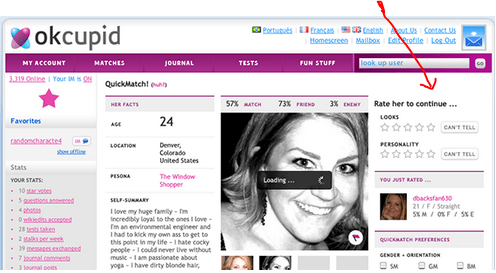
In this weekend’s Wall Street Journal “Review” section, Christian Rudder, president and one of the founders of OkCupid, wrote an article titled “When Websites Spy on Private Lives,” where the Harvard math grad discusses the experiments he runs on the data generated from OkCupid. It’s an incredibly engaging read that does two things: 1. Creates a bunch of buzz about his new book “Dataclysm” and 2. complicates how data mining and collecting private information from the traces we leave on the Internet should be perceived. His article was in response to the backlash he received when he published a post on OkCupid’s company blog outlining some of the experiments his site has been conducting. The title of the blog post: “We Experiment on Human Beings!

Basically, in the article, Rudder is trying to, clearly, defend his actions, promote his book, and cause trouble, but he’s also posing a question that is absolutely fundamental to our contemporary lives: Is mining the data of our personal information a benefit to society?

Screen shot taken from OkCupid blog.

To sum it up, Rudder is arguing that his company is not just benefiting from the mining of consumer data; the world is too. “Websites are amassing information that holds enormous social potential,” Rudder writes. “The data our users generate helps companies improve their sites and make money; that’s a story that most people know. But that same data could also unlock new ways of understanding society and new kinds of science.”

It’s hard to argue with Rudder that mining data can help people understand society, but it’s also hard to take that argument in concert with how that data benefits his company financially. As Rudder illustrates in the experiments on the people who are searching companionship and love on his site, the data is able to help him better understand what his users are looking for in relationships. He can improve his business. But strangely, the experiments helped point out that users are more likely to connect with other users if the site tells them they are compatible even if they’re not. In a sense, his experiment showed that users on OkCupid wanted to be told who is a companion, and their algorithm was not nearly as important as persuasion.

Rudder’s tone comes across like a mad-scientist entrepreneur who thinks he’s figured out how to crack social problems by mining data, and while he seems a little gruff and inappropriate, he does illustrate how OkCupid’s experiments can lead to interesting social behavior, because he can examine  behavior from users when these users think no one is watching, even though Rudder clearly is. For example, in the blog post on experiments, he learns that there is some racism happening in the online dating world. The New York Times pulled this from Rudder’s new book:

“As a group, for instance, Latino men rated Latinas as 13 percent more attractive than the average for the site, while they rated African-American women 25 percent less attractive. In fact, Mr. Rudder reports, black women on the site receive about 25 percent fewer first messages than other women do. For Mr. Rudder, these numbers unequivocally tell a story of racism.”

Okay, so you learned that we’re racist from our data. No shit.

Yes, clearly we can learn a lot about social behavior from the traces we leave behind on the Internet, from our clicks, from the content of our messages (even though you don’t need to mine the content of website to find racism still exists), but I’m not sure that I gave anyone permission to use me in a social experiment. In fact, I don’t think Rudder has the right to conduct social experiments. Sure, I understand what he’s trying to accomplish. He’s trying to argue that the collection of the content of messages, our clicks, our responses to other personalities online, when collected and analyzed will inform the world on human behavior; but it will also fuel his company. It also still feels like a major injustice to privacy. I just imagine Rudder sitting on the hill in his evil mansion, trying to find the thread that runs through all of humanity to figure us out. This is a strange, social engineering conceit that makes me uncomfortable.

I see the benefits of using my data, but what I think is the problem is that many people don’t really understand the lengths our information is used for social experimentation, targeted marketing, etc. Sure, the data is said to be collected anonymously and swirled around in some metaphorical vat of binary code or whatever bullshit they’re selling, but that data is me in there. I might only be a small portion of that data, but it’s me. And I believe my identity isn’t something you should just be able to trade and sell like a commodity.

Design by Joseph Lapin

But here is where things get complicated for me. I do see the benefit of collection of data from smart phones for smart cities. For example, if there was a city-run system where data could be collected and communicated with other parts of the city and DOT, then traffic could be handled differently. The collection of data from our homes could inform better environmental practices. There are benefits to collecting data and analyzing from a health perspective, too. Think about how Big Data could help the Ebola crisis? And perhaps I would be comfortable with this type of data collection if it was anonymous.

(What does anonymous collection of data actually mean? Who is out there ensuring that it is anonymous?)

The truth is that now we know how much our browsing history, our clicks, our time spent on a page can inform others about our behavior, well, I think it’s just time that we start seeing our computers, our smart phones, as an extension of our mind. We have the conscious mind and the subconscious mind. For example, our conscious mind is our browsing behavior, but the information mined from our data can provide insight into our subconscious mind. I don’t want marketing companies knowing more about my identity than a psychologist. I don’t want the Christian Rudders of the world sifting through the collected mind of America to try and better understand who we are. I don’t want him to rationalize data collection and privacy invasion by hiding behind social experimentation. I don’t want dating services, Google, Facebook, etc, to rationalize their creepy experiments without our consent by hiding behind the phrase: “We’re gaining a deeper understanding of humanity.”  I want transparency.

If making society a better place through understanding is a company’s goal, then they should say it up front. Don’t hide behind  terms and agreements. Be up front with people. Make that a part of your business. Be transparent.

In reality, I do think we can learn a lot about humanity through Big Data, but that power in the wrong hands scares me. The power to manipulate countless people through a change to a website is just a bit bizarre — almost Dr. Moreau-like. I don’t have an answer to the privacy debate. In fact, I feel that we’re already down a huge rabbit hole, and I have very little control over the outcome of how privacy will be defined in the 21st century, but I just wanted to stand up and say, slow down. My mind is not for you to experiment with. And neither is my browsing history.