This weekend I drove down to San Diego to start looking for a place to live, and I thought about how every city I’ve ever moved to has its own renting culture. Los Angeles apartments usually don’t come with a refrigerator; Boston you sometimes have to pay an extra moth of rent to the realtor; South Beach you can move into a place the day you start looking; and Long Beach you better not have a Pit Bull. Each city has its own way of navigating the renting process, so when we drove down to San Diego, I expected there to be a learning curve. I also didn’t expect to find a place on the first day. I remember when I moved to Long Beach my wife and I were looking for a month, and we were driving up and down the streets, trying to locate “For Rent” signs in front yards, and it felt like we would never find a place. I understood the struggle of finding the right place, and I expected to have to haggle with landlords. I expected to be forced to choose between our budget and what we wanted. And I expected to have enough tension and controversy to write an interesting blog post. But after looking at four places, Heron and I found a place we loved. We told the landlord how much we wanted to live there, sent over the credit check, paid the deposit, and we now have a rental. King of killed my blog idea. It was incredibly easy, this time, to find a place to live, and we’re actually thrilled with the results. So this started me thinking about all the times that I’ve moved across the country, and I thought about what it’s been like to look for a home, for a place to belong. I thought about all that I’ve learned by just looking for places to live. Here are five lessons I’ve learned over the years.
Design by Joseph Lapin
5. Watch Out for Desperation
When we were looking for places to live over the weekend, we came across a home close to North Park, San Diego. It was a single family home, but another tenant was living in the basement. The front yard had mulch instead of grass. There would have been plenty of room for my dog, but as soon as I knocked on the door and met the people living there, I was instantly suspicious. In turned out the current tenants were looking for someone to take over their lease. They had their three dogs locked in cages, and the dogs looked like they were trying to be on their best behavior, but if someone had opened their cages, then I would have regretted stepping foot in that home. The current tenants told us that they were moving out because they wanted to live closer to the beach. They had just moved from Kansas city. Four months were left on the lease. Now I couldn’t figure out why they would be in such a rush to get out of their apartment if they had four months left on their lease, and I could understand this idea if they were buying a home instead of renting — perhaps they landed a great deal — but breaking a lease or trying to sublet an apartment to live near the water, which is only ten minutes, sounded suspicious. I could smell the desperation to find a way out of a situation, and I didn’t want to be stuck in someone else’s trap. When I’m looking at places to live, I realize I’m being sold on a product, on a life, on a home, and like Odysseus on his way back to his wife, there are many detours and islands along the journey that are illusory when trying to find the place you belong, but you have to learn to separate false homes, false journeys, from the authentic ones. Continue reading “How to Find a Home: 5 Lessons from Finding a Place to Live”→
This weekend, I fled Los Angeles, work, and all my responsibilities and jumped on a jet plane to Walla Walla, Washington. I have never been to Walla Walla — or really ever heard about the place — but my family, who do enjoy wine tastings, raved about the town that is five hours outside of Seattle and closer to the Oregon border than you might expect. Honestly, I needed to get away. I’ve been anxious, trying to find the balance between my professional and creative life, and I thought spending time in a town where the only thing to do was farm or drink wine would provide the cure. So I went there with the idea that I would eat, drink, and take photographs. You’ll see some shots below.
Photo Credit Joseph Lapin
We stayed at a winery called Abeja, and we had the most fantastic rooms and the most incredible breakfast. I remember the last breakfast most distinctly. They brought over a baked egg seasoned with a bit of thyme, parmesan cheese, sea salt, and some light cream. Then they brought out bacon with sourdough waffles covered in fresh apples with a dollop of whipped cream. We drank their wine, too, which was good, but I have to be honest with you: I don’t know anything about wine. I wish that I did, but when I taste four or five different wines it’s really hard for me to tell the difference. I’m trying to learn and respect the craft, but one thing that I have learned from my family and friends is that all you have to do is say something descriptive like “minerality,” “apricot,” or any other floral or fruit taste, and people might actually think you know what you’re talking about. The people I was with knew wine, and it was fun to learn, but I was more interested in the sights in Walla Walla. And of course, the company.
Photo credit Joseph Lapin
What I loved most about Walla Walla was that everywhere I looked there was a different landscape photo opportunity. It was close to the high plains desert, and every piece of land was used to grow crops. It reminded me of a place Jack Kerouac would have loved to wander through, and he would have written about the people who worked the land. Because it was farmlands and they were growing different crops, the colors of the Earth altered as much as the contours of the landscape. Continue reading “Wine and Photography in Walla Walla, Washington”→
I’ve been fooling around with Adobe Illustrator lately, trying to become better at my job as a creative director and learn to add more interesting content to my blog and journalism. It’s clear that if you’re going to be a writer in the digital age, then you should have an understanding of creative software like Photoshop, Adobe Premier, Final Cut, Illustrator, etc. (just look at BuzzFeed), and I want to improve my skills so I can create endlessly across multiple platforms. I’ve come across some great designers recently that have inspired me to work on the craft even more. I have a way to go, but that’s fine. My creative life is taking new shapes and forms, and I’ll follow this where it leads. Of course, my first love will always be the written word, but I have been finding design inspiration everywhere I look. The designers that have really inspired me recently are David Plunkert, James Yang, and Whitney Sherman.
Design by Joseph Lapin
As I begin to experiment in this new medium and look to other designers for inspiration, I understand that this is only going to take my writing to the next level because it will add a visual element to correspond with the text. (Of course, illustrations will not make the actual writing better.) But this train of thought brought me to a new idea for a blog post. I started to think about how painters have influenced my actual writing. When I was teaching freshmen composition, I would always bring in paintings to help my students understand how to create detailed and vivid scenes in their personal essays, and I would point to painters to illustrate the way that details can powerfully convey meaning. I started to “sketch” scenes in my journal, after reading Vincent Van Gogh’s letters to his brother Theo, and I kept them in my journals. In some ways, painters have actually inspired me to create stories and poetry more than some authors. So I wanted to blog, today, about three painters who have influenced my writing.
3. Vincent Van Gogh
Design by Joseph Lapin
I didn’t think much about Vincent Van Gogh when I was younger, but then my father and I went on a trip to Amsterdam and stopped at the Van Gogh Museum. I stepped into that museum without expecting anything other than a cultural experience, and I walked out completely changed. What I loved about the museum was that his paintings were curated in a chronological fashion, so as you moved throughout the museum, you would begin to see Vincent’s story take shape. It hit me hard, because like Theo, Vincent brother, I have also had loved ones who have been touched by mental illness. I won’t delve into too many personal details, but for the longest time, mental illness brought my family pain, and it was reassuring to be able to witness the same pain and suffering yet beautiful moments that Vincent and Theo shared in their letters and in Vincent’s paintings. From this experience, I was able to see that beauty and profundity could come from so much confusion and struggle. It put me on the path to start beginning to write about some of the incidents I’ve witnessed in my life. It put me on a path to defend the mentally ill. It put me on a path to tell stories.
2. Neo Rauch
Design By Joseph Lapin
I first came across Neo Rauch when I was studying at the Prague Summer Writing Program sponsored by Western Michigan University, and a local museum was featuring some of his work. I had never heard of Neo Rauch, but when I walked into the artistic space I had a similar experience as in the Van Gogh Museum. He was blending elements from comic books and suburban life from the 1950s with elements of science fiction and the surreal. What I admired most about Neo Rauch was that he was able to create universes in his paintings, somewhat like Kurt Vonnegut or Ray Bradbury in their fiction, that seemed fantastic and surreal but were governed by clear rules. The characters in his paintings are able to move back and forth between separate worlds (in the physical and mental sense), and this forces his work to exist in that weird space between the realistic and the absurd, because his images are rendered with an almost hyperbolic tangibility that can only be compared to having a dream where you know that you’re in a dream but everything is so clear, sensual, and defined that it feels like you’re awake. Ah, that was a long thought.
Neo Rauch
There is one painting that always startled me by Neo Rauch. It’s above. It seems to suggest that someone is sleeping, and I can’t help but feel the characters in their white coats are nothing but figures from a dream. They seem from another time. I want to be able to create stories where dream worlds and physical universes almost fold into each other. I want to find a way to write between the dream and the real world. Two writers that I admire who pull this off exceptionally well are Denis Johnson and Marcel Ayme. I want to find a way to capture this quality. I’m far off, but it’s a goal.
3. Norman Rockwell
Design by Joseph Lapin
Well, if you’ve been following my blog or my writing, then you might be aware of the project I created called “Rockwell’s Camera Phone.” Basically, it was trying to imagine how Norman Rockwell would have seen the world today. What really fascinates me about Norman Rockwell is that he was able to take the most ordinary moments of American life and make them universal. He was able to take a young boy sitting at a diner next to a cop and transform that image into one of the most iconic images in American history. He was able to make art and illustration speak directly to as many people as possible. But most importantly, he was able to find the poetry in the everyday. In a lot of ways, he reminds me of a poet like Frank O’Hara. Of course, they’re different realms and styles, but they were able to find the sublime in the old man sitting on the crate begging for change or just the general activity of a Main Street in New England. They were artists who were able to find the sublime in running to finish errand. They were the artists who found the sublime in walking down the street or on their way to pick up a sandwich for lunch. They were the artists who found that life, ordinary,everyday ritualistic life, was the sublime. I’m from a small town in New England. Art still exists in those streets. There is still poetry. There is still beauty, even if it feels ordinary. I would love to tap into that, and I’m trying.
So I’m not sure if this at all wraps up to a cohesive whole. But these are painters that I admire tremendously, and they’ve made me want to write. Okay, I’m tired and want to watch Boardwalk Empire. Leave a comment below and let me know some of the painters who have inspired you in your creative life.
I grew up in Clinton, Massachusetts — a small town in Worcester County. We were once the crowning achievement of the Industrial Revolution, and the factories from the Bigelow Carpet Factory are still on Main Street, serving as a reminder of a former life. I love Clinton. I still have family there, and I have incredible friends there. That town has helped me become the man I am today, but I couldn’t wait to leave when I was a kid. It’s not that I disliked the people or thought it wasn’t a great town; it’s that I hated the snow; I hated the cold; I hated the small-town nature of my childhood existence. It just wasn’t where I wanted to live long term. I needed to find my home, and there were two places I knew where I wanted to live: Florida and California.
I started to develop this fascination with the idea of paradise. I started to think about the ocean, the sun, and the weather. I thought about Florida and California, and I built these ideas of these states as the key to happiness and success. That once I moved beyond the cold winters my life would be easier, more peaceful, and free.
Design by Joseph Lapin
So I went to college in Florida, and I lived there for four years, and I studied creative writing in Miami for three. Now I live in California — the place where I thought would be the most free state in the country — and I’m about to move to San Diego. What I’m trying to say is that I understand what it’s like to live in a place that most people consider paradise. I know what it’s like to live in a city where tourists line up, year after year, with their cameras to take photographs. I know what it’s like to take for granted the beauty that surrounds me and become accustomed to beautiful weather that you almost feel oblivious to the flowers blooming almost all year round or standing on the beach only to turn around and see snow on the mountaintops. What I’m trying to say is that I’ve spent the last ten years of my life chasing paradise, and I’m no longer looking for it. I’ve found it, and I can’t imagine ever leaving it. It’s obviously a state of mind. It’s a place that I can find in my writing. It’s my family. It’s music. Even though it’s so obvious, it’s important to remind myself that paradise is not a place. That’s what is on my mind this week.
Here are some quotes from writers on paradise:
“It is better to have your head in the clouds, and know where you are … than to breathe the clearer atmosphere below them, and think that you are in paradise.” — Ralph Waldo Emerson.
“I have always imagined that Paradise will be a kind of library.” — Jorge Luis Borges.
“Dogs are our link to paradise. They don’t know evil or jealousy or discontent. To sit with a dog on a hillside on a glorious afternoon is to be back in Eden, where doing nothing was not boring–it was peace.” — Milan Kundera.
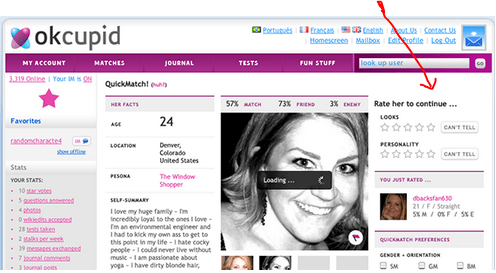
In this weekend’s Wall Street Journal “Review” section, Christian Rudder, president and one of the founders of OkCupid, wrote an article titled “When Websites Spy on Private Lives,” where the Harvard math grad discusses the experiments he runs on the data generated from OkCupid. It’s an incredibly engaging read that does two things: 1. Creates a bunch of buzz about his new book “Dataclysm” and 2. complicates how data mining and collecting private information from the traces we leave on the Internet should be perceived. His article was in response to the backlash he received when he published a post on OkCupid’s company blog outlining some of the experiments his site has been conducting. The title of the blog post: “We Experiment on Human Beings!”
Basically, in the article, Rudder is trying to, clearly, defend his actions, promote his book, and cause trouble, but he’s also posing a question that is absolutely fundamental to our contemporary lives: Is mining the data of our personal information a benefit to society?
Screen shot taken from OkCupid blog.
To sum it up, Rudder is arguing that his company is not just benefiting from the mining of consumer data; the world is too. “Websites are amassing information that holds enormous social potential,” Rudder writes. “The data our users generate helps companies improve their sites and make money; that’s a story that most people know. But that same data could also unlock new ways of understanding society and new kinds of science.”
It’s hard to argue with Rudder that mining data can help people understand society, but it’s also hard to take that argument in concert with how that data benefits his company financially. As Rudder illustrates in the experiments on the people who are searching companionship and love on his site, the data is able to help him better understand what his users are looking for in relationships. He can improve his business. But strangely, the experiments helped point out that users are more likely to connect with other users if the site tells them they are compatible even if they’re not. In a sense, his experiment showed that users on OkCupid wanted to be told who is a companion, and their algorithm was not nearly as important as persuasion.
Rudder’s tone comes across like a mad-scientist entrepreneur who thinks he’s figured out how to crack social problems by mining data, and while he seems a little gruff and inappropriate, he does illustrate how OkCupid’s experiments can lead to interesting social behavior, because he can examine behavior from users when these users think no one is watching, even though Rudder clearly is. For example, in the blog post on experiments, he learns that there is some racism happening in the online dating world. The New York Times pulled this from Rudder’s new book:
“As a group, for instance, Latino men rated Latinas as 13 percent more attractive than the average for the site, while they rated African-American women 25 percent less attractive. In fact, Mr. Rudder reports, black women on the site receive about 25 percent fewer first messages than other women do. For Mr. Rudder, these numbers unequivocally tell a story of racism.”
Okay, so you learned that we’re racist from our data. No shit.
Yes, clearly we can learn a lot about social behavior from the traces we leave behind on the Internet, from our clicks, from the content of our messages (even though you don’t need to mine the content of website to find racism still exists), but I’m not sure that I gave anyone permission to use me in a social experiment. In fact, I don’t think Rudder has the right to conduct social experiments. Sure, I understand what he’s trying to accomplish. He’s trying to argue that the collection of the content of messages, our clicks, our responses to other personalities online, when collected and analyzed will inform the world on human behavior; but it will also fuel his company. It also still feels like a major injustice to privacy. I just imagine Rudder sitting on the hill in his evil mansion, trying to find the thread that runs through all of humanity to figure us out. This is a strange, social engineering conceit that makes me uncomfortable.
I see the benefits of using my data, but what I think is the problem is that many people don’t really understand the lengths our information is used for social experimentation, targeted marketing, etc. Sure, the data is said to be collected anonymously and swirled around in some metaphorical vat of binary code or whatever bullshit they’re selling, but that data is me in there. I might only be a small portion of that data, but it’s me. And I believe my identity isn’t something you should just be able to trade and sell like a commodity.
Design by Joseph Lapin
But here is where things get complicated for me. I do see the benefit of collection of data from smart phones for smart cities. For example, if there was a city-run system where data could be collected and communicated with other parts of the city and DOT, then traffic could be handled differently. The collection of data from our homes could inform better environmental practices. There are benefits to collecting data and analyzing from a health perspective, too. Think about how Big Data could help the Ebola crisis? And perhaps I would be comfortable with this type of data collection if it was anonymous.
(What does anonymous collection of data actually mean? Who is out there ensuring that it is anonymous?)
The truth is that now we know how much our browsing history, our clicks, our time spent on a page can inform others about our behavior, well, I think it’s just time that we start seeing our computers, our smart phones, as an extension of our mind. We have the conscious mind and the subconscious mind. For example, our conscious mind is our browsing behavior, but the information mined from our data can provide insight into our subconscious mind. I don’t want marketing companies knowing more about my identity than a psychologist. I don’t want the Christian Rudders of the world sifting through the collected mind of America to try and better understand who we are. I don’t want him to rationalize data collection and privacy invasion by hiding behind social experimentation. I don’t want dating services, Google, Facebook, etc, to rationalize their creepy experiments without our consent by hiding behind the phrase: “We’re gaining a deeper understanding of humanity.” I want transparency.
If making society a better place through understanding is a company’s goal, then they should say it up front. Don’t hide behind terms and agreements. Be up front with people. Make that a part of your business. Be transparent.
In reality, I do think we can learn a lot about humanity through Big Data, but that power in the wrong hands scares me. The power to manipulate countless people through a change to a website is just a bit bizarre — almost Dr. Moreau-like. I don’t have an answer to the privacy debate. In fact, I feel that we’re already down a huge rabbit hole, and I have very little control over the outcome of how privacy will be defined in the 21st century, but I just wanted to stand up and say, slow down. My mind is not for you to experiment with. And neither is my browsing history.


 This weekend I drove down to San Diego to start looking for a place to live, and I thought about how every city I’ve ever moved to has its own renting culture. Los Angeles apartments usually don’t come with a refrigerator; Boston you sometimes have to pay an extra moth of rent to the realtor; South Beach you can move into a place the day you start looking; and Long Beach you better not have a Pit Bull. Each city has its own way of navigating the renting process, so when we drove down to San Diego, I expected there to be a learning curve. I also didn’t expect to find a place on the first day. I remember when I moved to Long Beach my wife and I were looking for a month, and we were driving up and down the streets, trying to locate “For Rent” signs in front yards, and it felt like we would never find a place. I understood the struggle of finding the right place, and I expected to have to haggle with landlords. I expected to be forced to choose between our budget and what we wanted. And I expected to have enough tension and controversy to write an interesting blog post. But after looking at four places, Heron and I found a place we loved. We told the landlord how much we wanted to live there, sent over the credit check, paid the deposit, and we now have a rental. King of killed my blog idea. It was incredibly easy, this time, to find a place to live, and we’re actually thrilled with the results. So this started me thinking about all the times that I’ve moved across the country, and I thought about what it’s been like to look for a home, for a place to belong. I thought about all that I’ve learned by just looking for places to live. Here are five lessons I’ve learned over the years.